We get ‘Sense of Belonging’ wrong

I used to dress as a Victorian.
Weird opening, sorry. Also, this wasn’t a fashion choice.
Years ago, I put on a period costume and worked at Blists Hill Victorian Town in Ironbridge. This is a living history museum that tries to take you back in time. Real cobbled streets, working exhibits, staff in costume, a proper old school chippy…
Some of these things really matter, but not how you might think.
I’ll come back to that.
Sense of Belonging in Higher Education
In a uni, and particularly in Widening Participation (WP) work, belonging has become one of the most talked about things over the last decade. We’re obsessed with trying to get students to feel a sense of belonging at uni, with their course, with the city, with their faculty, with other students…
There is evidence that students who feel like they belong at uni, do better, are less likely to drop out, and give us really good NSS scores.
So student facing programmes often include this in their planning. Induction programmes… peer mentoring schemes… extra-curricular activities… we treat belonging as an outcome. Something that we are trying to make happen, and we measure whether it has with a survey.
I’m not actually sure this should be the way we look at it.
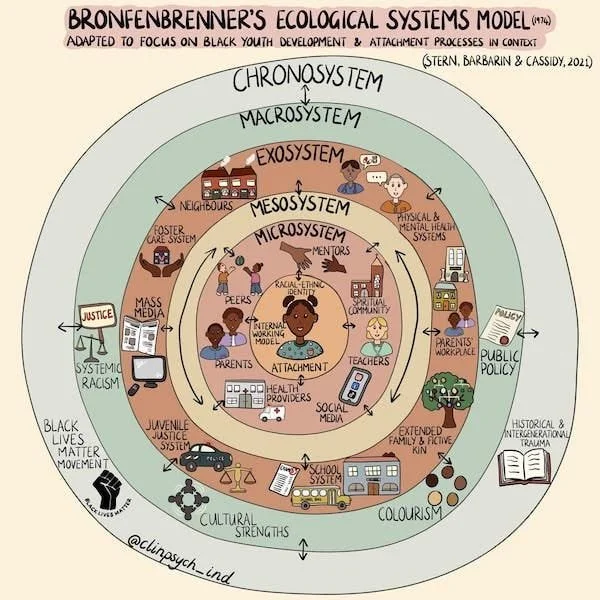
Bronfenbrenner applied to a social issue. Image found here.
I attended a webinar last week with some colleagues, on a special issue of Studies in Higher Education focused on the dynamic nature of students' sense of belonging. Some really interesting papers, I’ll link it at the bottom for you to read about.
There were some key themes that stood out to me:
Belonging is not static, it fluctuates over time, going up and down.
It’s massively social, and can mean very different things in different groups.
It requires agency and the student to choose to engage, for it to happen.
More than one paper drew on Bronfenbrenner’s Ecological Systems Theory. The idea is that belonging isn’t located in one place, but is influenced by the individual, their peers, their institution, their town or city… it’s fluid and dynamic and really abstract.
This all matters, because if belonging emerges across all these different layers, and is dynamic, social, specific, and based on students own agency, you can’t design a programme to ‘making belonging happen’. And you can’t just ‘achieve belonging’, and then walk off because it’s there now.
It’s all harder and more interesting than that.
If it isn’t an outcome… what is it?
After the webinar, we all had a debrief. My colleague George proposed something that I had started to consider too.
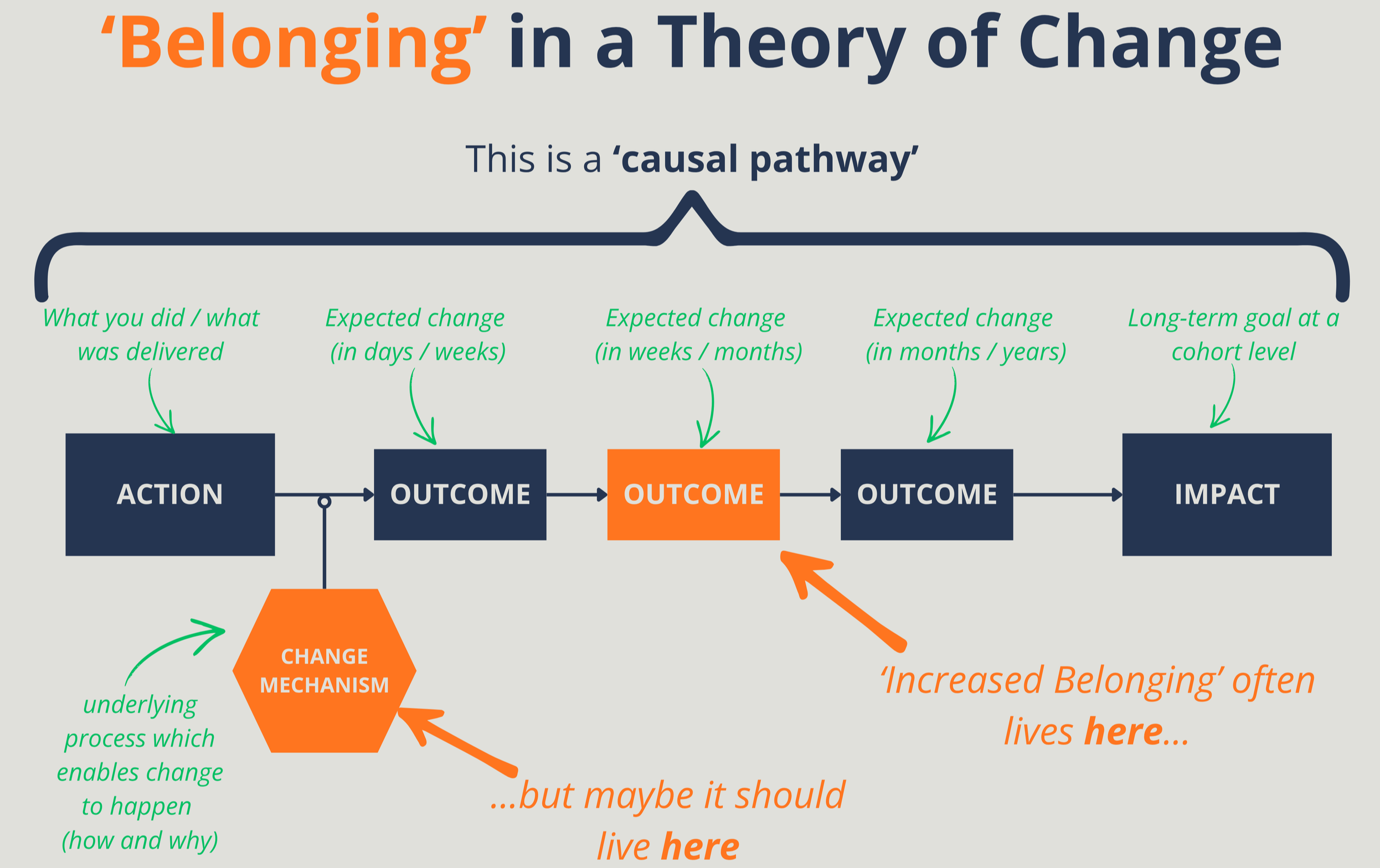
What if belonging isn’t an outcome at all? What if belonging is a ‘change mechanism’.
Change mechanisms appear on a more developed Theory of Change, and represent the condition or process that needs to happen, for everything to properly work in your programme or intervention.
Think about this: Students don’t fully engage with university, or your programme… they don’t reflect on their own development, or build collective identity… they don’t develop agency or feel a sense of empowerment, unless they first feel in someway that they belong.
Belonging brings you into the space and creates the conditions for you to then go on and thrive, or develop.
TASO’s describes Change Mechanisms as “…the underlying, often invisible processes that drive the change we hope to see…”
Belonging can fit with this.
Proper chippy chips
I want to take you back to Blists Hill.
When I spoke to visitors, there were lots of reasons why they kept coming back. But there was one thing, particularly for the regulars, that came up a lot. And people spoke about it like it was their little secret.
It was the chips.

Picture from the Shropshire Star… where there is an entire article about the chips!
Blists Hill has a chippy, where the chips were cooked in ‘the Victorian way’ with ‘real beef dripping’ and served in 1900’s style newspaper, like the Victorians would have. “They just taste proper”
There was something about the authenticity of it, the realness, that had people coming back.
People talked about it like it was their history. When they got into the museum, they’d first head to the chippy, and then walk around the streets with them. The smell and taste helped them connect to a place.
It was emotional, and it became theirs. And it opened them up to the wider experience of being a Victorian. They engaged with it more fully, more emotionally, than they would have done without the chips.
The chips didn’t produce an outcome on their own, but they created a condition under which outcomes become possible.
I don’t think it was designed or planned this way, but if you were mapping a causal pathway, from ‘exhibits’ > ‘increasing engagement’ > ‘passion for history’, then the chippy is a mechanism.
Belonging from a train in Sheffield

One more anecdote, while I’m on a roll.
About a decade ago, and working at Sheffield Hallam Students’ Union, I led a research project exploring what causes a sense of belonging for students at Sheffield Hallam.
One student told me exactly when they first felt that sense of belonging.
It wasn’t during freshers’ week, or making friends on their course, or downing quad vods in Corp.
It was on a train, coming back after a weekend home, tired, and feeling unsure of themselves.
As their train pulled into Sheffield station, they caught a glimpse of the top of a uni building with the words “Sheffield Hallam University”, just about visible.
They felt a wave of pride, contentment, and a feeling of being home. Just that brief moment, and they felt a wave of belonging.
What comes after that?
Increased commitment to university… engagement… identity… A willingness to stick it out when uni was hard, and to get through university successfully. This was made more possible because belonging arrived first and help unlock it.
It was the mechanism for change.
So, what do we do with this?
If belonging is a mechanism, rather than an outcome, then there are some things we need to do differently.
Measuring belonging as an outcome might be the wrong approach. If we care about things like academic engagement, attainment, personal development… belonging is the thing that makes these things possible. We need to see how belonging levels link to those variables.
If we only focus on belonging, then the programme is limited. A programme that only focuses on belonging is like only having a Victorian chippy, and not the whole town and staff and exhibits and experience.
Programmes like peer mentoring, peer-assisted learning, student community building… these are really hard to evaluate. If we see belonging as a dynamic, uniquely developed, and as a mechanism, then we need to rely far more on qualitative methodologies, rather than scales.
Most importantly, if belonging is a mechanism, then our evaluation question needs to change. We no longer ask “did our programme improve belonging?”, and need to ask “did our programme create conditions for belonging to emerge, and did that belonging enable our outcomes?”.
This is harder for sure, but it’s better to ask the harder correct question, than the easy wrong one.
Belonging or… becoming?
There was one more key thing that came up in the webinar.
Several participants in the chat started to discuss the connection between belonging and ‘becoming’.
This is the process through which students develop their identities, in context with their setting. Who they are, who they might be. And the argument is, you can’t fully ‘become’, without first ‘belonging’. You need to feel safe, a recognition of your place, a sense of being seen and accepted by others. These are conditions for you to develop your identity and sense of self.
To become.
This makes sense to me. The student on the train had a sense of pride that wasn’t just about belonging at Sheffield Hallam. It was about their sense of self. “This is who I am, I’m where I need to be.”
When people talked about their little secret of finding the chips at Blists Hill, there is an element of it being linked to their identity. Their story. “I know where you need to go first! To the chippy!”
Belonging enabled becoming. The mechanism allowed the outcome to happen.
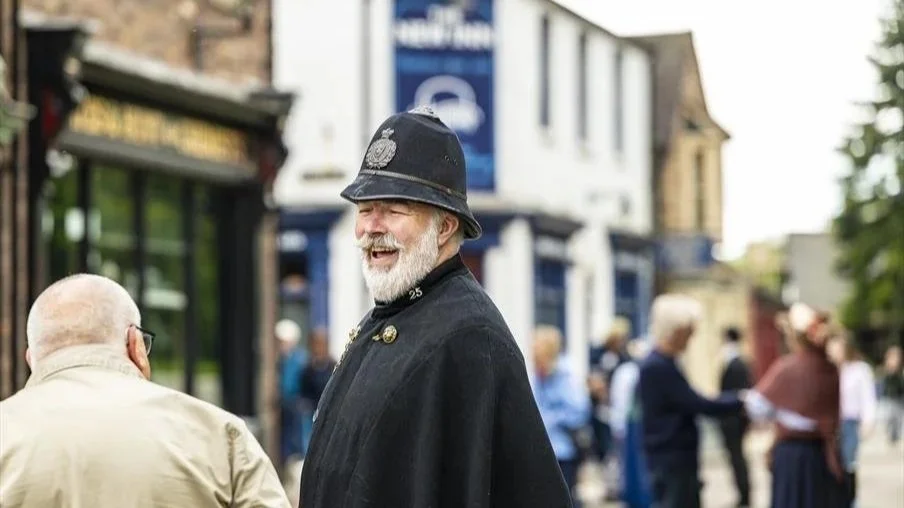
And if you do visit Blists Hill, make sure you seek out the Guy the policeman. He’s a wonderful man.
What next?
Loving beef-dripping chips at Blists Hill wasn’t an outcome. It was the thing that made people engage with ‘Victorian life’.
Feeling content because you saw a building from a train wasn’t an outcome. It was a moment that made a young person a Hallam student, who engages and thrives at uni.
Belonging, I’d argue, works this way too. This isn’t what we should aim to produce, it’s a condition under which, things we’re trying to produce, happen.
We should design for it as a condition, a mechanism, and think about evaluating it on those terms. And remember that these stories aren’t found in a scale, or a data point. They need evaluation that gives the juicy details.
Evaluation was never easy, was it?
Further Reading:
There are some great papers about Belonging here.
These were presented during the webinar, and are well worth a look, if this is your bag!
