Kids in the Shire get left behind
This weekend I went away with some old school friends. After a day that included fiercely competitive Padel, and too many pints in a beer garden in the sun, we sat around chatting with the TV on in the background. Late in the evening, Lord or the Rings came on.
How nostalgic!

As the camera swept through those rolling green hills with those Hobbit houses, we’re introduced to the fun parochial little village, and the main bit of excitement for those little folks is the equivalent of a village fête. It reminded me of my home county of Shropshire.
And it should.
Tolkien drew on that West Midlands landscape when he imagined the Shire. Shropshire is filled with loads of lovely little villages, the rolling south Shropshire hills, and several places where you can buy homemade jam.
It also has some of the lowest rates of access and participation to higher education in the country.
There is a gap between what the place looks like, and what life actually offers to young people growing up there. And the way we measure deprivation and targeting of outreach provision, means universities are blind to it.
And it’s going to get worse.
A visibility problem
WP teams across the country, are working with less. Fewer staff, tighter budgets, more difficult targets. When resources are scarce, decisions get made about where to concentrate effort.
When you need to start targeting your limited resource, it makes sense to go for areas of high population, lowest POLAR schools, highest Free School Meals (FSM). The big dark red spots on a map. Those schools are on the OfS radar and are named in access agreements.
Rough inner-city schools, where crime is measurably high, poverty is visible, gangs run the streets, dark grim industrial centres swallowing up any joy or hope… You can easily picture it. It’s grim, like that bit where Saruman has all those Orks working away in a big factory…
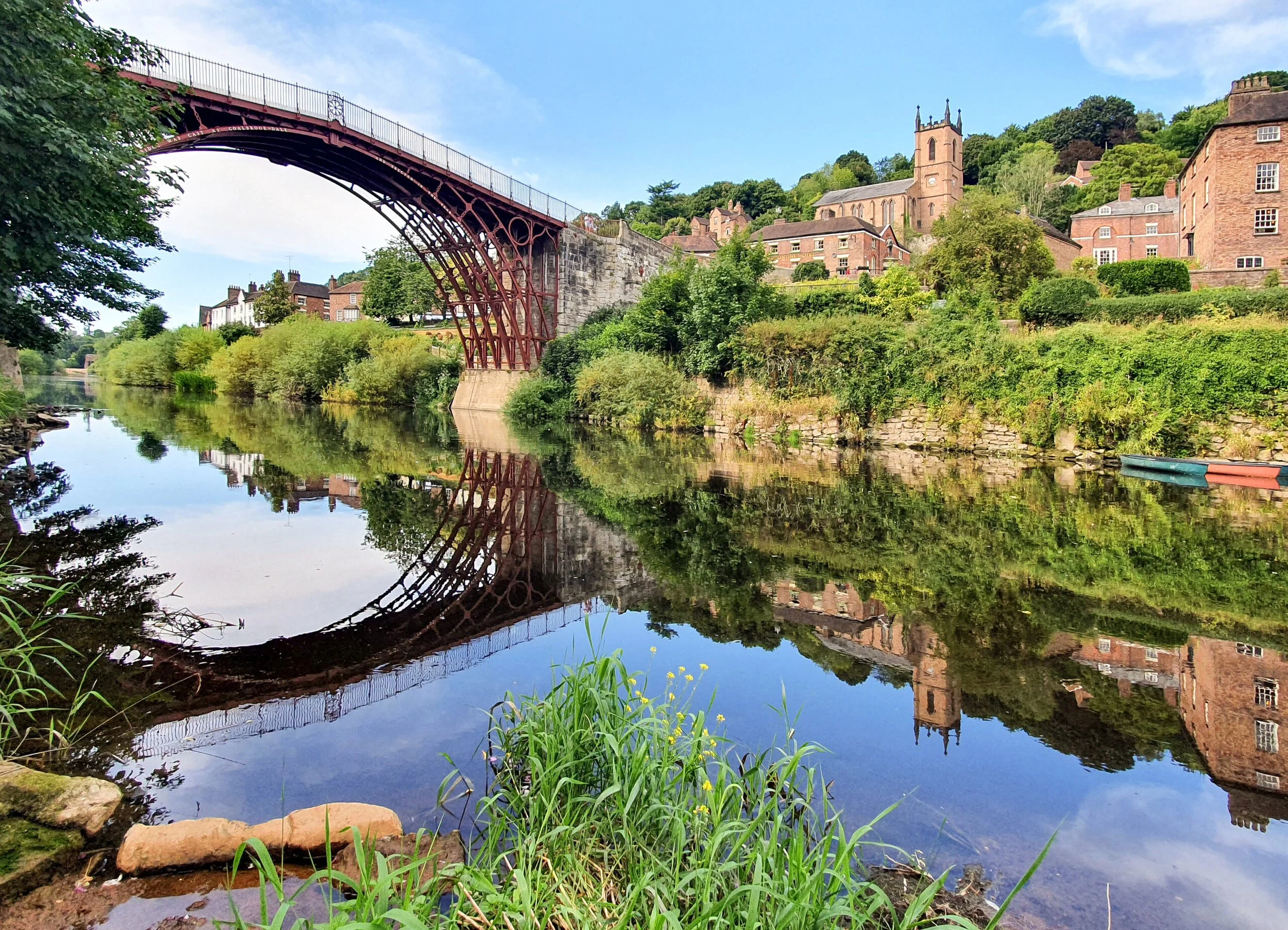
The lovely Ironbridge. It’s genuinely really pretty. And there is massive deprivation literally just up the road…
Okay, that metaphor got a bit weird. But you know what I mean. That’s where funders like to target money and what attracts the attention.
And that’s totally real, I’m not arguing against it.
But deprivation and lack of opportunity doesn’t just look like that.
Sometimes it looks like a little village in Shropshire, surrounded by fields, 52 minutes from the nearest train station, where the youth centre is a shed, where career opportunities don’t really exist except for those low skill low wage jobs, where the high street is 3 shops and two of them are those places where you sell ‘gold’ for pennies, and the only bus you can rely on is the school bus. Where it is literally impossible to get out of it unless you have a car, and now it’s even more difficult to buy the petrol, let alone the car itself. You have to spend what little money you have on taxis just to get to your work experience.
That kind of deprivation is harder to see.
That gets averaged out by properly nice villages nearby, with gastropubs and people with massive driveways with a row of ceramic plant pots and pristine white gravel. It makes the area level data look fine, but there will be small pockets of young people who face massive barriers.
Why Rural Schools Get Left Behind
This issue isn’t just ‘my theory’. It is backed up by evidence. In 2021, the University of Bath described the urban ‘escalator effect’, through their analysis of 800,000 students. They found disadvantaged students from urban areas are more likely to enter elite UK universities than similar peers from rural communities.
The current financial situation is going to compound this.
To be clear, it isn’t intentional. It isn’t a conspiracy to ignore rural communities or small towns. It’s just that the data and ‘strategy’ points in one direction. And I think the key issues are these:
Density. Urban areas offer something rural areas can’t. Concentration.
One visit to an inner city in Nottingham reaches hundreds of FSM students. The same staff time spent travelling to a rural village might reach twenty, and you’re in that area with the white gravel drives again. When you’re managing shrinking teams against a target, then the targeting gets brutal.
Visibility. Urban deprivation shows up as big red blobs in heatmaps.
That data drives WP targeting. FSM rates, POLAR quintiles, IMD scores. Rural deprivation is flattened by the posh village next door. The nice posh village that has an artisanal food festival sits next door to the ex-mining town where young people don’t see uni for them.
Logistics. Getting kids from a rural school is a massive undertaking.
For that school, transport costs money, teacher cover costs money, parents might need to take time off… the barriers to engagement that urban schools face are compounded in rural settings, by pure geography. I can’t hammer home enough how RUBBISH getting the bus somewhere is when you live rural, in comparison to being in a city.
Scaling. We work out ‘what works’ in our pilot schools, and then expand it out.
We always test our interventions on the most challenging schools, or the one where the deputy head is excellent and we have a great relationship. Then if we’re lucky, we can expand it to other schools. If we ever finally get this programme in a rural school, it’s not even fit for purpose anymore! The issues that affect rural kids aren’t necessarily the same as those in inner-city schools.
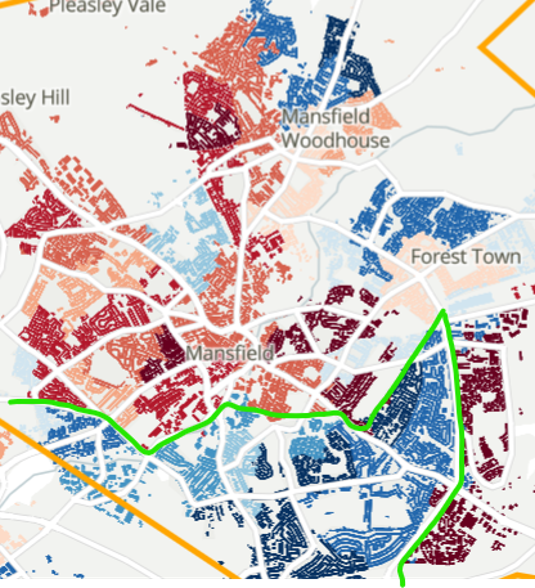
I used this image before, but I’m bringing it back. That big dark blue bit in the south, hides deprivation in the east and north, if you just look at Mansfield as an area.
The posh village next door. When the population is sparse and not dense, there are fewer data points.
When small communities are scattered across a county, mixed in with genuinely affluent communities, they disappear. You can even see this on a town level. Mansfield for example on a town level, isn’t too bad. But the really wealthy south part of the town hides the deprivation in the east and northern estates, where there are real problems. It’s harder to see when the numbers are lower.
You’d think we’d be coordinating…
I’ve set out the issue. But there is something that makes all of this worse.
Those urban areas that a WP targets, over the rural community, isn’t just the focus of one team.
Multiple universities, and even social mobility charities, run programmes in the same schools, sometimes even with the same cohorts, because those schools are visible, and the relationship is there.
In rural areas, the opposite happens. Nobody coordinates.
Universities, charities, youth groups… they all target and make decisions in isolation. But those decisions follow the same logic: Where are the numbers? Where are the ‘engaged’ schools? Where are the highest numbers of FSM kids? This results in the same schools being seen by three different providers, while other schools get missed.
There is little coordination, and some kids lose out.
What do we do instead?
This isn’t an argument for abandoning deprived inner-city schools. Those young people we see in Nottingham where I live, or elsewhere, genuinely need the help.
But if we are serious about our mission, and in particular when resourcing is tight, we need to be very careful.
Consider:
Which schools in your region received no support in the last 3 years. Not just your school, ANY SCHOOL. I’d put money on it being not the worst school, but somewhere forgotten.
Your target school selection. Are you working with certain schools because of need, or because the pre-existing relationship is really good…
Whether you can scale for rural schools. There is a transport/geographic barrier first and foremost. And there are other things that make those areas unique. Don’t think your on campus city-based activity will work.
Coordinating with other providers. We need a better system level view of coverage. We need heads of WP not just to communicate, but plan together. Without this, we will keep making perfectly rational decisions that come to the same conclusions, and then act on it individually.
Being as granular as you can with targeting. We need to make sure that those area level averages are not hiding things. We need to spend time with the data to fully spot those kids that are being missed.
Returning to the Shire
Widening Participation should be for everyone.
The funny thing about the Lord of the Rings comparison is that in the books, the Shire gets absolutely decimated by all of the conflict. In the films, even that bit is left out. Once the characters get out of the Shire, they don’t think about the area again until the end of the trilogy, and as an afterthought. The rural bit gets forgotten about again!
This is a plea for those who have to make tough decisions in tough times.
It’s easy to remember the visibly deprived inner-city areas and those kids who are suffering. It’s harder to remember and work with those rural kids who are hidden by averaged out data, lack of numbers, and picturesque greenery.
Samwise Gamgee would have been blown away by a post-16 campus visit.

“They do excellent taters in the student canteen, Mr Frodo…!”
