The assumptions behind the ‘Hard Hat and the Graduation Cap’
Andy Burnham made a statement last week about how his government will value the hard hat as much as the graduation cap.
The policy plan behind the statement signals big changes. Does the rationale hold up?
I am broadly in favour of the idea, but I think there are some massive assumptions being made. And as we know, assumptions floating about in your Theory of Change are a big problem.
I think applying Manchesterism in somewhere like Mansfield, isn’t as straightforward as you think. Mansfieldism, for example, may be a different ballgame entirely.

What is being proposed?
The Burnham Government’s new plan is to put technical and academic education on equal footing from age 14. From that age on, pupils will be able to combine core academic subjects with technical education. This is shaped by schools, colleges, mayors, and local industries that matter in their area.

Local employers and local economies are the bedrock of all of this. This bit is important…
So what is the Theory of Change?
Behind all of this policy and politics, I can see a fairly classic logic chain. I’ll lay this out, and I think this is the important bit that gets overlooked.
Everyone focuses on the ‘activity’(“Hey Andy, what are you going to do?”) and the ‘inputs’(“Hey Andy, how are you going to pay for all of this?”). Far fewer people look at the ‘rationale’ or the ‘mechanisms’ or ‘outcomes’ (“Hey Andy, what are the preconditions that you expect to achieve for the change to happen…?”)
The problem it thinks it’s solving: technical routes have been treated as ‘second-best’. This means some young people get funnelled towards degrees that don’t suit them, while employers in some industries struggle to find people with the right skills locally. Certain local areas (particularly outside of London) therefore have a lack of local talent, and the number of NEETs (Not in Education, Employment, or Training) rises.
The rationale it argues to address this: Raise the status and quality of technical pathways, link them to local employer demand. Then young people take them up. Then young people move into local jobs. Individual outcomes (wages, employment, life satisfaction) and regional outcomes (productivity, reduced regional inequality) improves.
Sounds fine… what are the assumptions?
I think there are two big problems with this. Assumptions being made, that aren’t being accounted for. This impacts the Theory of Change behind the policy.
Assumption 1: Local employer demand is a good proxy for good opportunity. The assumption here is that what employers in an area currently want young people to get qualified for, is the right thing to build a young person’s career pathway around.
I think this is a big problem. Where you are born shouldn’t dictate the type of opportunity you should be funnelled into.
Assumption 2: A qualification is the thing standing between young people and jobs. The assumption here is that the biggest barrier to entry in sectors is the lack of credentials. Get the technical qualification, and the job follows.
I don’t think this is true. For example, many technical jobs, and progression through them, is linked to years of practical experience in the role and learning on the job.
Mansfieldism as a test case
I’ve spent time looking closely at Mansfield through my work at NTU. It’s a great case study to stress-test this theory because it’s the kind of town this policy is meant to help.
It is also the kind of place where people have big misconceptions about the town and its people. And assumptions are what we like to challenge.
Employer demand and the local economy
The massive assumption that people make about places like Mansfield (ex-mining town, still reeling from deindustrialisation, etc.) is that it has a jobs shortage. Looking at the data, this isn’t true [all data in this section found on the ONS website]
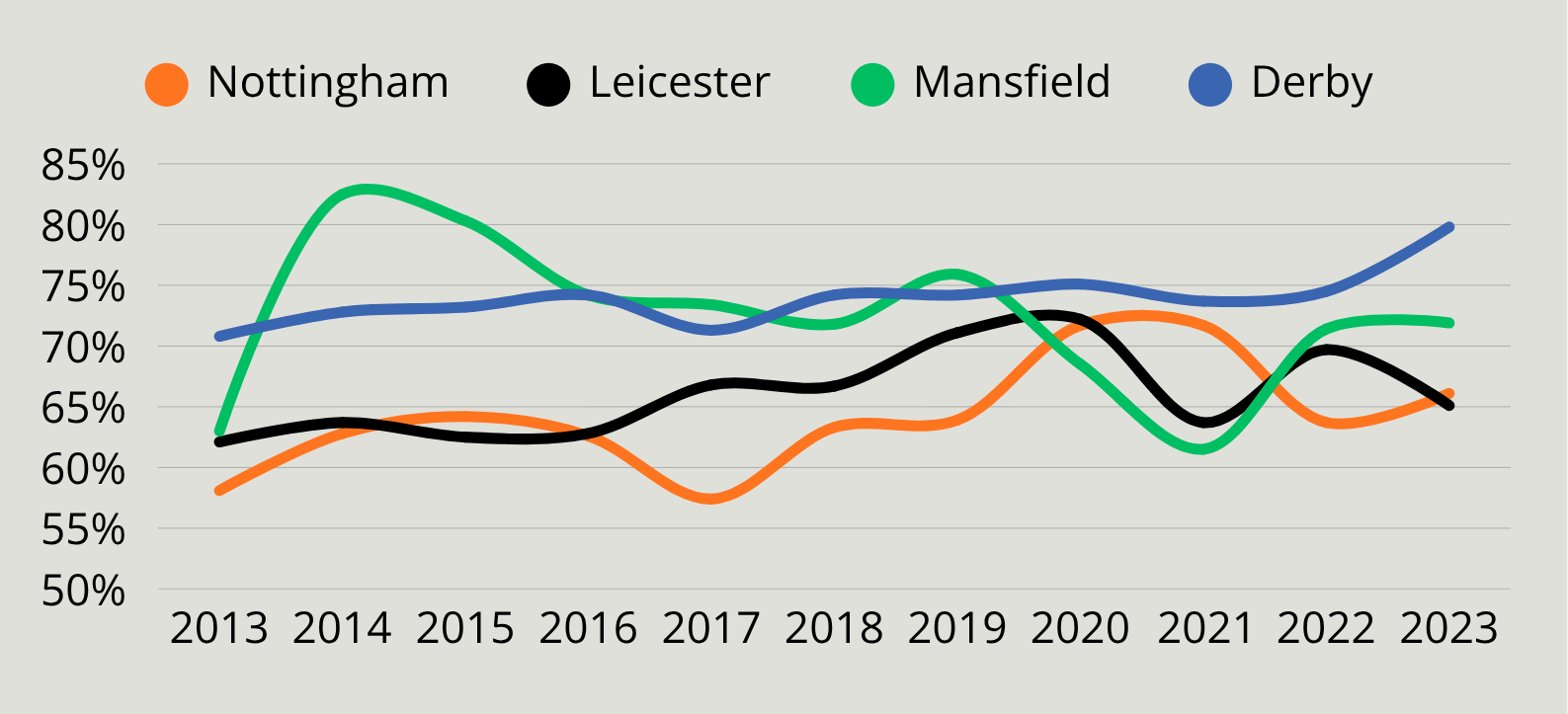
I’ve compared Mansfield’s employment rate to other comparators in the East Midlands. Mansfield does alright. It looked like it got hit by Covid pretty hard, but it has bounced back.
What is different is the type of work.
Here is some data showing the proportions of occupations for the Mansfield Population against the England average. It skews massively towards ‘elementary occupations’, and ‘process, plant and machine operatives’. But if you look at those higher paid ‘professional and technical occupations’, or even the ‘managers, directors, and senior officials’, the proportion is far lower.
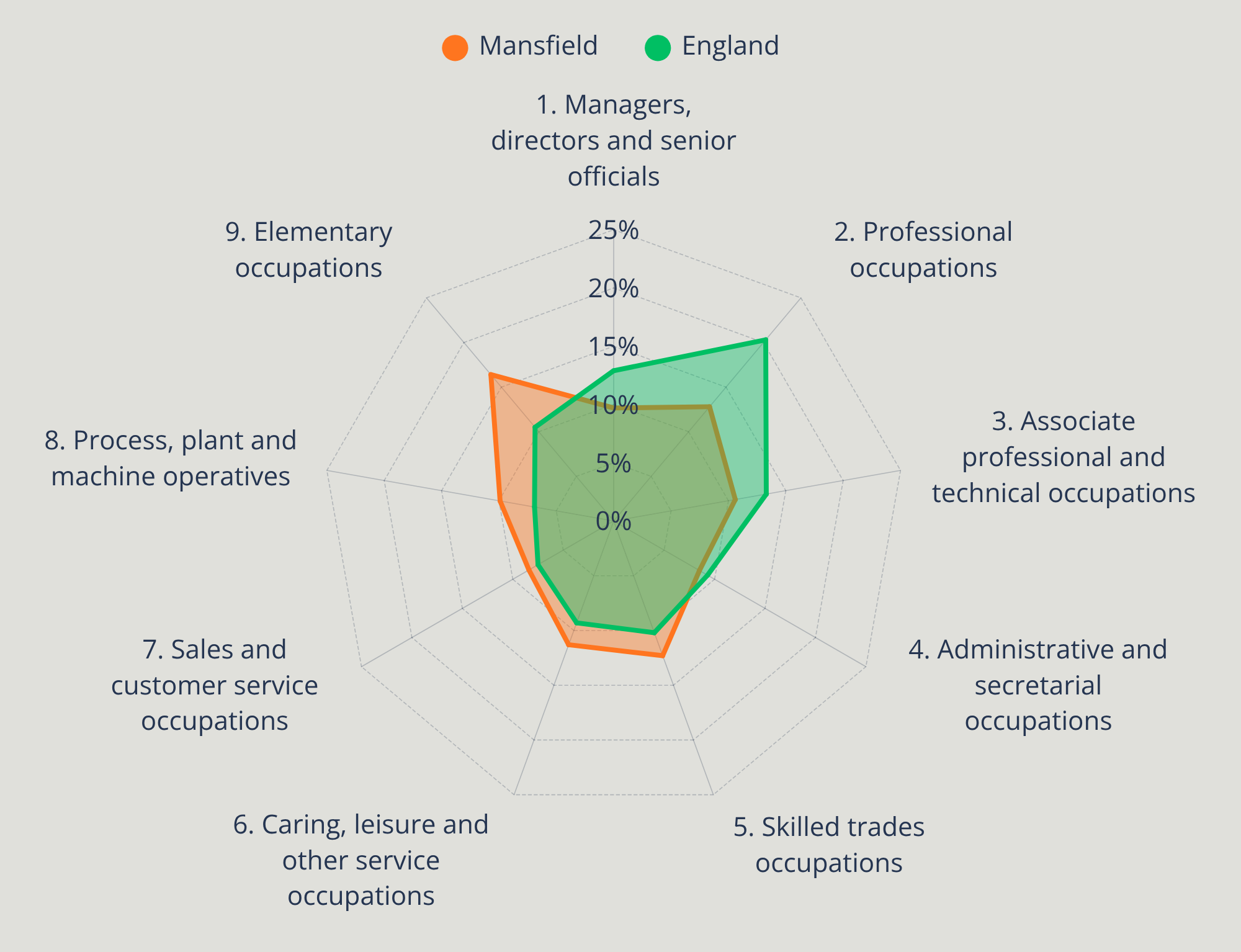
Effectively, there is a job ceiling.
Also something interesting, is that there is a difference in the nature of work. People in Nottingham City (where I live) are considerably more likely to work from home, or travel more than 10km to their job. People in Mansfield are far more likely to travel, but only within a 10km radius.
This speaks to job availability.
Jobs with a longer commute, or the option to skip that commute altogether and work from home, tend to sit alongside jobs with a national reach, more flexibility, and often better pay. A tight local radius tends to sit alongside the opposite. A narrower band of roles, that are capped locally.
So, with all of this, if you build a technical pathway around local employer demand, in a place where local employer demand is restricted and progression is limited, you’ve built a really efficient road, to a small number of places.
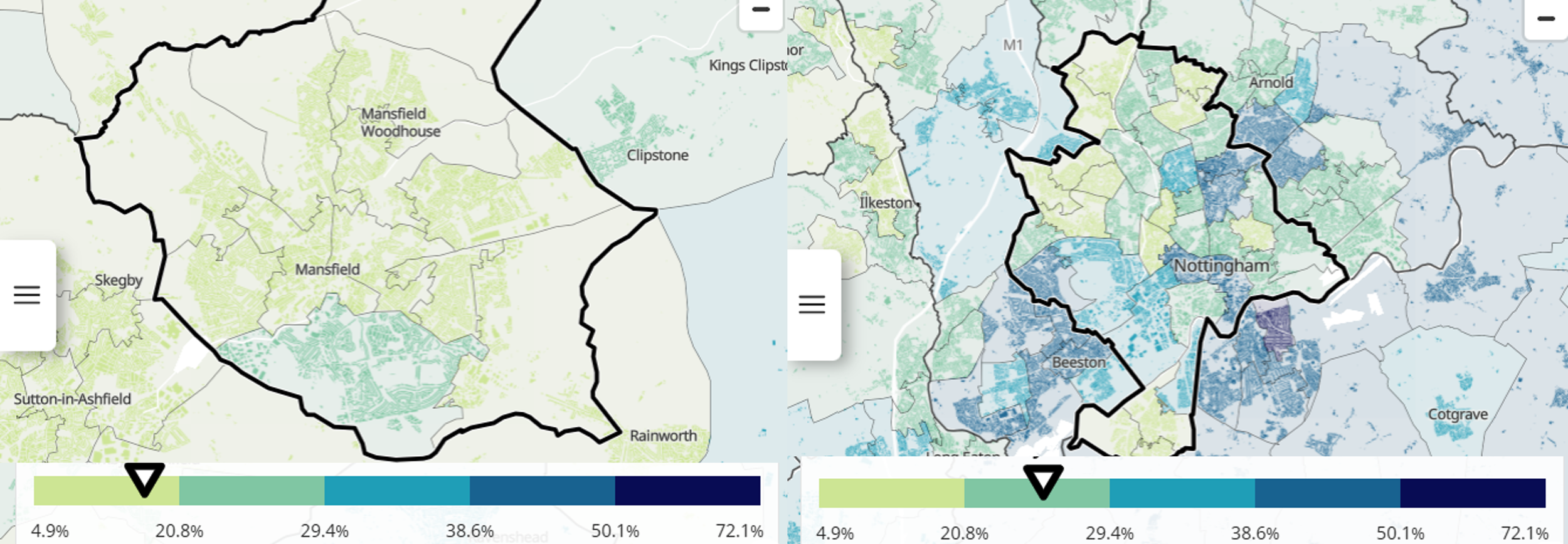
A person's place of work and their method of travel to work. Proportion of "Work mainly from home" by postcode
I don’t think this is what the policy is trying to do.
Now I know that the policy itself is talking about future growth, but the sector has to be built on something. An existing employer base.
And the forward-looking bit also links to the other assumption.
Qualifications addressing barriers
There are definitely some sectors where this applies. And changing the value judgement on hard hats vs graduation caps is important. There are lots of trades that genuinely pay well, and require qualifications.
My cousin never went to uni and is a gas engineer. He’s had to do multiple technical exams to qualify, and is excellent at his job. I also haven’t asked him, but I strongly suspect he out-earns me and his other university graduate cousins.

Found from Mansfield Skills Plan 2020-2030 (Mansfield.gov)
If you have a problem with your plumbing and heating in Shropshire, I know a guy. He’s a success, and technical qualifications have helped him get there.
But taking this back to Mansfield, I had a look at their District Council skills plan, to see where the growth predictions are in jobs, by industry. The biggest area of growth isn’t gas engineers. It’s health and social care.
This is a massively important sector, but entry and progression in this sector runs mostly on experience, and a care certificate, not formal technical qualifications.
If a technical pathway is built to feed people into this sector, you’ve built a very expensive path into a job market, that was never blocked because of a lack of qualifications.
There are many other sectors like this, where building technical qualifications is great to upskill the workforce… but isn’t a requirement for getting into it. So what’s the point?
This isn’t Mansfield specific either. It happens all over the country.
What this means for theory
The Theory of Change behind the policy has a structural weak point if the local labour market is narrow, or wherever the target sector doesn’t actually ‘gate’ based on qualifications.
The inputs and activities are all very reasonable. I agree with the premise, and I like the idea of building up local areas and not telling young people to just go to uni and then move to London, in order to be a success.
I don’t want to move to London thanks.
But the concern here is that the causal chain is supposed to link the activities through to impact. And that chain might work in Manchester where the local economy is varied, it might work less well in other areas.
Testing that the theory is working
So I have some concerns. But I could well be wrong. In fact, I hope I am.
The only way to know is to test it. So how would I evaluate this policy?
1) Track destinations, progression, and mobility, not just qualification rates (testing assumption 1). It isn’t good enough to get a qualification and get a job. This is about helping young people get good jobs, and progress. So test that.
2) Compare between sectors (testing assumption 2). If qualifications have no impact on progression, then you’re not addressing the problem. Explore it, and consider every sector, not just overall levels.
Hard hats and graduation caps
I’ve used Mansfield as a case study here, not because the town is unusual or in some way deficient. It isn’t. It’s a great place, and I think it is a success.
I’ve name-checked several technical jobs here, not because they are ‘lesser’ or in some way deficient. They aren’t. Technical jobs are massively important and are valued.
I’ve discussed this policy, not because I think it is a bad idea, or as a way to score points against our new PM. It isn’t a bad idea. I want this to work.
But thinking through this stuff is what I do. Whether it’s social mobility, widening participation, or government policy, it needs to be evaluated to ensure things get better.
